Medical ABS
Medical-grade ABS filament is a thermoplastic made from high-quality Acrylonitrile Butadiene Styrene (ABS). Ivory in color and rigid in appearance, it is designed for applications involving skin contact. Manufactured from granules compliant with ISO 10993-5 standards, this material meets the requirements for biocompatibility in contact with the skin. It is particularly suitable for producing 3D parts such as surgical planning models, as well as prototypes of housings and interfaces used in patient monitoring devices.
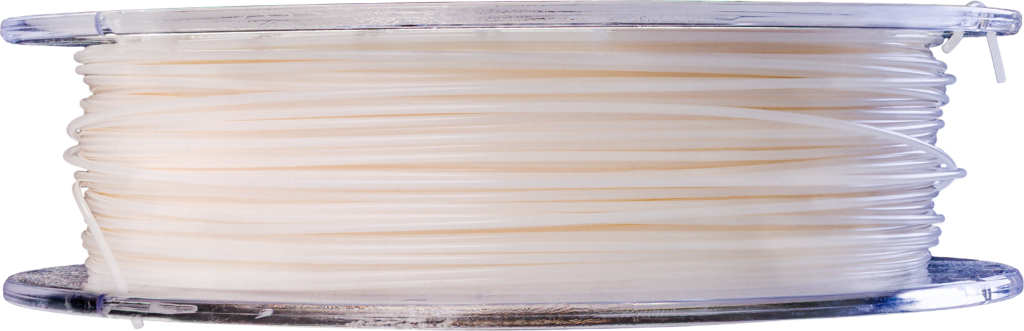
The medical-grade ABS
Technical characteristics
- Material: Acrylonitrile Butadiene Styrene (ABS)
Color: Ivory
Appearance: Rigid
Diameter: 1.75 mm and 2.85 mm
Spool weight: 500 g
Origin: Made in France
Type: Skin contact
Printing properties
To ensure reliable prints suitable for medical applications, the following parameters are recommended:
- Extrusion temperature: 220 – 240 °C
Bed temperature: 100 – 115 °C
Print speed: 20 – 50 mm/s
A dedicated printing profile is available on Ultimaker Cura to optimize performance and print quality. ABS typically requires a controlled printing environment, preferably with an enclosed chamber, to minimize warping and ensure dimensional stability.
Its biological and functional properties
- Compatible with skin contact (ISO 10993-5)
- High mechanical strength
- Good impact resistance
- High thermal resistance
- Low deformation
These properties make ABS a reliable material for functional prototypes and medical devices requiring durability and resistance to mechanical stress.
Its application areas
Medical ABS filament is particularly suitable for the following healthcare applications:
- Surgical planning models
- Anatomical models
- Orthoses
- Prototypes of medical device housings
- Patient monitoring interfaces in contact with skin
Advantages and precautions
Advantages
- High thermal resistance
- Good mechanical strength
- Excellent impact resistance
- Low warping compared to standard ABS
- Suitable for skin-contact applications
Precautions
- Printing recommended in an enclosed environment
- Sensitive to temperature variations during printing
- Store in a dry environment
- Ensure proper ventilation during printing
- Use optimized parameters for consistent results
Need support?
Whether you are developing medical devices, surgical guides or technical instruments, our team supports you from material selection through to technical validation.
Please contact us to discuss your requirements and find out how our filament can support your medical 3D printing projects.