Medical PLCL
The POLY-CAPROLACTISSE 70/30 [PLCL] medical-grade filament is a poly(lactide-co-caprolactone) copolymer composed of 70% lactic acid and 30% caprolactone of high quality. Transparent and flexible in appearance, this material is characterized by its high elasticity and progressive resorption, occurring within 12 to 24 months after implantation. Thanks to a glass transition temperature close to ambient temperature, it maintains flexibility well suited for biomedical applications requiring soft mechanical behavior.
Implantable, bioresorbable, and biocompatible, it is particularly suitable for applications requiring flexibility and adaptation to moving tissues.
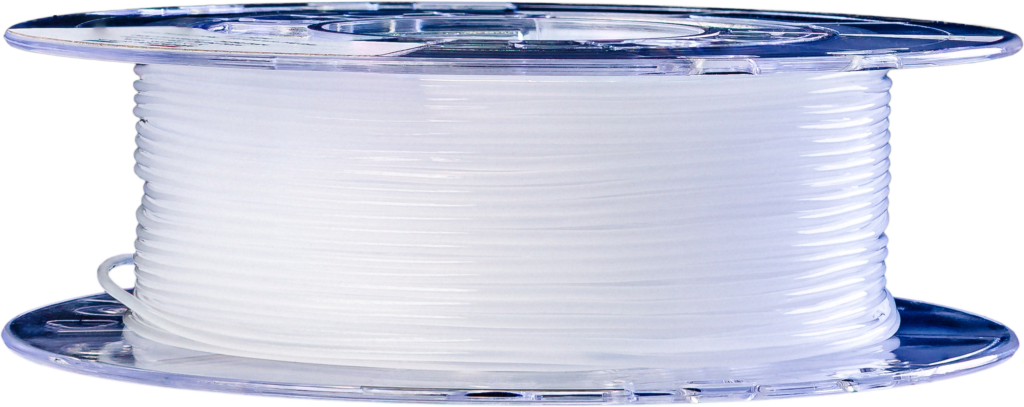
Zoom on medical PLCL
Its technical specifications
- Nature: Semi-crystalline thermoplastic
- Color: Transparent
- Appearance: Flexible
- Diameter: 1.75 mm – 2.85 mm
- Weight: 100 g – 200 g
- Origin: Made in France
- Properties: Bioresorbable, biocompatible, implantable, flexible
Its printing properties
To ensure reliable prints suitable for medical applications, the following parameters are recommended:
- Extrusion temperature: 180–230 °C
- Bed temperature: 35–55 °C
- Printing speed: 20–60 mm/s
PLCL is sensitive to storage conditions. It should be stored under vacuum with a desiccant, protected from light, and kept at low temperatures (between -4 °C and -20 °C). Before use, exposure to ambient air should be minimized to preserve its properties.
Its biological and functional properties
- Medium-term bioresorbable (12 to 24 months)
- Biocompatible
- Implantable
- Flexible
- Soft
- Controlled and progressive degradation
Its flexibility and elasticity make it particularly suitable for devices requiring adaptation to physiological movements and soft tissues.
Its areas of application
Medical-grade PLCL filament is particularly suitable for:
- Meshes for soft tissue reinforcement
- Nerve regeneration guides
Its advantages and precautions
Advantages
- Controlled resorption (12 to 24 months)
- Excellent biocompatibility
- High flexibility
- Suitable for soft tissue applications
- Implantable
- Compatible with 3D printing (1.75 mm and 2.85 mm)
Precautions
- Store between -4 °C and -20 °C
- Keep in airtight packaging with a desiccant
- Protect from light
- Avoid prolonged exposure to moisture
- Restore proper storage conditions after extended periods of non-use
Need support?
Whether you are developing medical devices, surgical guides or technical instruments, our team supports you from material selection through to technical validation.
Please contact us to discuss your requirements and find out how our filament can support your medical 3D printing projects.