Medical-grade PCL
Medical-grade PCL filament is a biocompatible thermoplastic made from high-quality Polycaprolactone (PCL). White in color with a semi-flexible appearance, it stands out for its unique ability to be both implantable and bioresorbable over an extended period of more than 36 months.
Thanks to its glass transition temperature being below ambient temperature, PCL retains a certain level of flexibility. This makes it particularly suitable for biomedical applications requiring both adaptability and controlled degradation over time. It is widely used in tissue engineering for scaffold fabrication, as well as for implantable devices such as osteosynthesis plates and screws, and resorbable sutures.
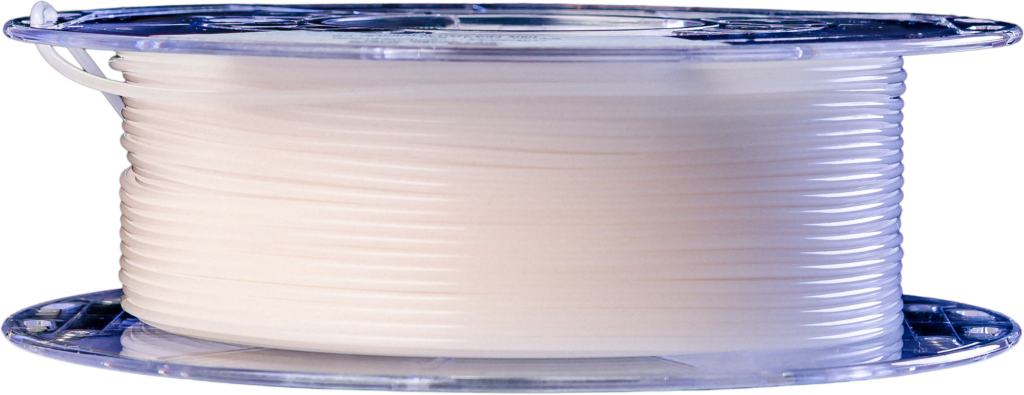
Zoom on medical-grade PCL
Its technical specifications
- Material: Polycaprolactone (PCL)
- Color: White
- Appearance: Semi-flexible
- Diameter: 1.75 mm and 2.85 mm
- Spool weight: 100 g and 200 g
- Origin: Made in France
- Type: Implantable, bioresorbable
Its printing properties
To ensure reliable prints suitable for medical applications, the following parameters are recommended:
- Extrusion temperature: 160 – 200 °C
- Bed temperature: 40 – 45 °C
- Print speed: 20 – 60 mm/s
Proper parameter tuning is essential to ensure dimensional stability and preserve the material’s mechanical properties. As a low glass transition polymer, PCL requires precise bed temperature control to ensure good adhesion.
Its biological and functional properties
- Biocompatible
- Bioresorbable
- Implantable
- Slow degradation (over 36 months)
- Controlled flexibility at room temperature
Thanks to its gradual degradation behavior, PCL enables the design of temporary medical devices that support tissue regeneration before being naturally resorbed by the body.
Its areas of application
Medical PCL filament is particularly suitable for the following healthcare applications:
- Tissue engineering (scaffolds)
- Resorbable implantable devices
- Osteosynthesis plates and screws
- Resorbable sutures
- Support structures for cell regeneration
Its advantages and precautions
Advantages
- Bioresorbable
- Biocompatible
- Implantable
- Slow and controlled resorption
- Ideal for tissue engineering applications
Precautions
- Vacuum storage with desiccant recommended
- Store away from light
- Optimal storage temperature between -4 °C and -20 °C
- Sensitive to long-term storage conditions
- Requires precise printing parameters
Need support?
Whether you are developing medical devices, surgical guides or technical instruments, our team supports you from material selection through to technical validation.
Please contact us to discuss your requirements and find out how our filament can support your medical 3D printing projects.